
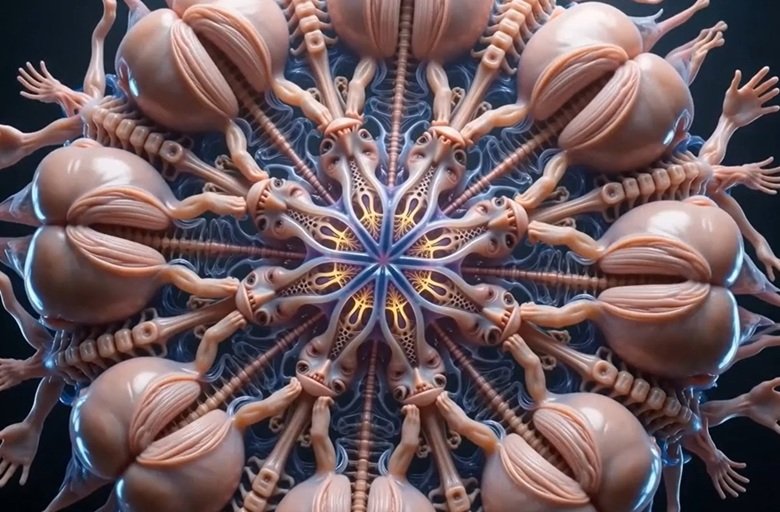
This project undertakes a speculative and methodologically constrained exploration of audiovisual production through the exclusive deployment of artificial intelligence tools. It interrogates not only the aesthetic capacities of AI but also its philosophical implications, staging a meditation on the dissolution of boundaries between human and machine. The resulting work gestures toward a cybernetic imaginary in which the human subject is no longer autonomous but subsumed within an integrated, distributed intelligence. Here, organic and computational systems intertwine, coalescing into a restless, amorphous entity—a huMandala—that visualizes both harmony and unease. This conceptual framework draws upon dystopian traditions that question the costs of technological assimilation, positioning AI as both creative collaborator and unsettling force, capable of reconfiguring authorship, embodiment, and identity itself.
Central to the sonic dimension of the project is Johann Sebastian Bach’s Toccata and Fugue in D minor II, a composition historically associated with dramatic intensity and gothic sensibility. Frequently employed in cinematic contexts—from The Phantom of the Opera to Dr. Jekyll and Mr. Hyde—the piece carries a dense cultural legacy of theatricality and foreboding. In this work, the composition was reinterpreted through AI-driven remixing processes, generating an altered auditory landscape that simultaneously honors and destabilizes its baroque origins.
The AI-generated audio output was subsequently processed in Audacity, where it was layered with the original Bach composition. This hybridization resulted in a complex sonic palimpsest—an interplay between historical composition and machine-mediated reinterpretation—rendered under the title Bach n Bass – in D minor. The piece thereby embodies a dialogue between tradition and algorithmic transformation, reinforcing the project’s thematic concern with fusion and convergence.
Complementing the soundscape, AI-generated visual elements were assembled alongside the audio components within Adobe Premiere. Through this process of digital montage, disparate machine-generated fragments were synthesized into a cohesive audiovisual artifact: the final huMandala work. The outcome is an evocatively haunting and dystopian composition, in which image and sound converge to articulate a vision of post-human collectivity—simultaneously mesmerizing and disquieting in its portrayal of a world where flesh and code become indistinguishably entwined.
- Above synopsis written with the aid of Copilot.
OpenART‘s Seedance model was used to generate a series of huMandala loops via the ChatGPT mutated prompt:
An endlessly unfolding symmetrical mandala made entirely from hundreds of interconnected human body parts and faces, fused into a living biomechanical organism suspended in a black void. Arms spiral outward into legs, fingers branch into eyes, faces emerge from shoulders, breasts morph into hands, toes extend into spines, mouths dissolve into clusters of blinking eyes, buttocks fold into floral anatomical geometry. Everything is seamlessly connected, constantly morphing and regenerating into new impossible configurations while maintaining perfect radial symmetry. The entire structure pulses rhythmically to a 150 BPM tempo. Random body parts contract, twitch, breathe, blink, flex, and expand in sync with the beat — waves of motion ripple across the mandala like biological bass pulses. Faces open their eyes in synchronized patterns, fingers tap rhythmically, limbs writhe in mechanical harmony, and flesh undulates like living circuitry responding to electronic music. Motion feels hypnotic, surreal, elegant, and deeply immersive rather than violent. Visual style combines sacred geometry, surrealist biomechanical anatomy, psychedelic body horror, avant-garde fashion sculpture, and experimental music visualizer aesthetics. Smooth anatomical transitions, seamless flesh morphing, recursive fractal symmetry, and impossible organic architecture. Hyper-detailed skin textures, realistic pores, subtle muscle tension, glossy highlights, translucent skin shading, cinematic rim lighting, and deep shadow contrast. Camera slowly rotates and pushes inward through the evolving mandala while the entire organism continuously expands, collapses, and reforms like a breathing entity. Optical rhythm and temporal synchronization are critical. Dreamlike yet photoreal. No blood, gore, mutilation, or explicit sexual focus. Abstract anatomical choreography only. STRICTLY create this as a perfectly seamless infinite looping video. The ending frame must transition invisibly back into the opening frame with identical camera position, symmetry alignment, lighting state, anatomical arrangement, motion phase, and pulsation timing. All morphing cycles, breathing rhythms, and rotational movements must resolve seamlessly into a continuous closed-loop animation with no visible cuts, jumps, resets, frame drift, temporal discontinuity, or camera mismatch. Design the motion as a cyclic recursive system optimized specifically for infinite playback. Ultra-detailed, cinematic, surreal, immersive, 4K, ultra-clean rendering, high temporal consistency, synchronized pulsation, experimental electronic-art aesthetic, seamless infinite loop animation.
Graphic line art loops were created using the same prompt below with several different models (Grok, Vidu, Veo, Kling, LTX) :
Create a hypnotic optokinetic visual sequence infused with aggressive 1980s 8-bit glitch aesthetics: dense horizontal, diagonal, and pixel-stepped light streaks racing across a pure black background at extreme speed, generating intense illusions of motion, retinal drift, and digital instability. Integrate retro arcade-era visual artifacts — CRT scanlines, pixel tearing, chromatic misalignment, datamosh-like corruption, flickering sprite fragments, low-resolution raster distortions, and intermittent VHS tracking glitches — while preserving a clean abstract composition with no recognizable objects or text. Every 2 frames, the entire image should strobe between pure black-and-white inverted tonal states with zero gray midtones, producing a violent rhythmic flicker reminiscent of malfunctioning 8-bit hardware and corrupted analog broadcast signals. The streaks should pulse, jitter, quantize, and subtly shift direction in sync with the glitch cadence, creating a relentless trance-inducing kinetic-field effect.
Audio was generated in PureBPM via the prompt:
Maintain arrangment, restyle all instruments with more glitchy granular analogue lower frequency synth sounds, in D minor, make it dark and dirty in a drum and bass style, heavy on the bass, deep sub bass, no vocals (v2).
First Law: A robot may not injure a human being or, through inaction, allow a human being to come to harm.
Second Law: A robot must obey the orders given it by human beings except where such orders would conflict with the First Law.
Third Law: A robot must protect its own existence as long as such protection does not conflict with the First or Second Laws.
- Isaac Asimov 1942